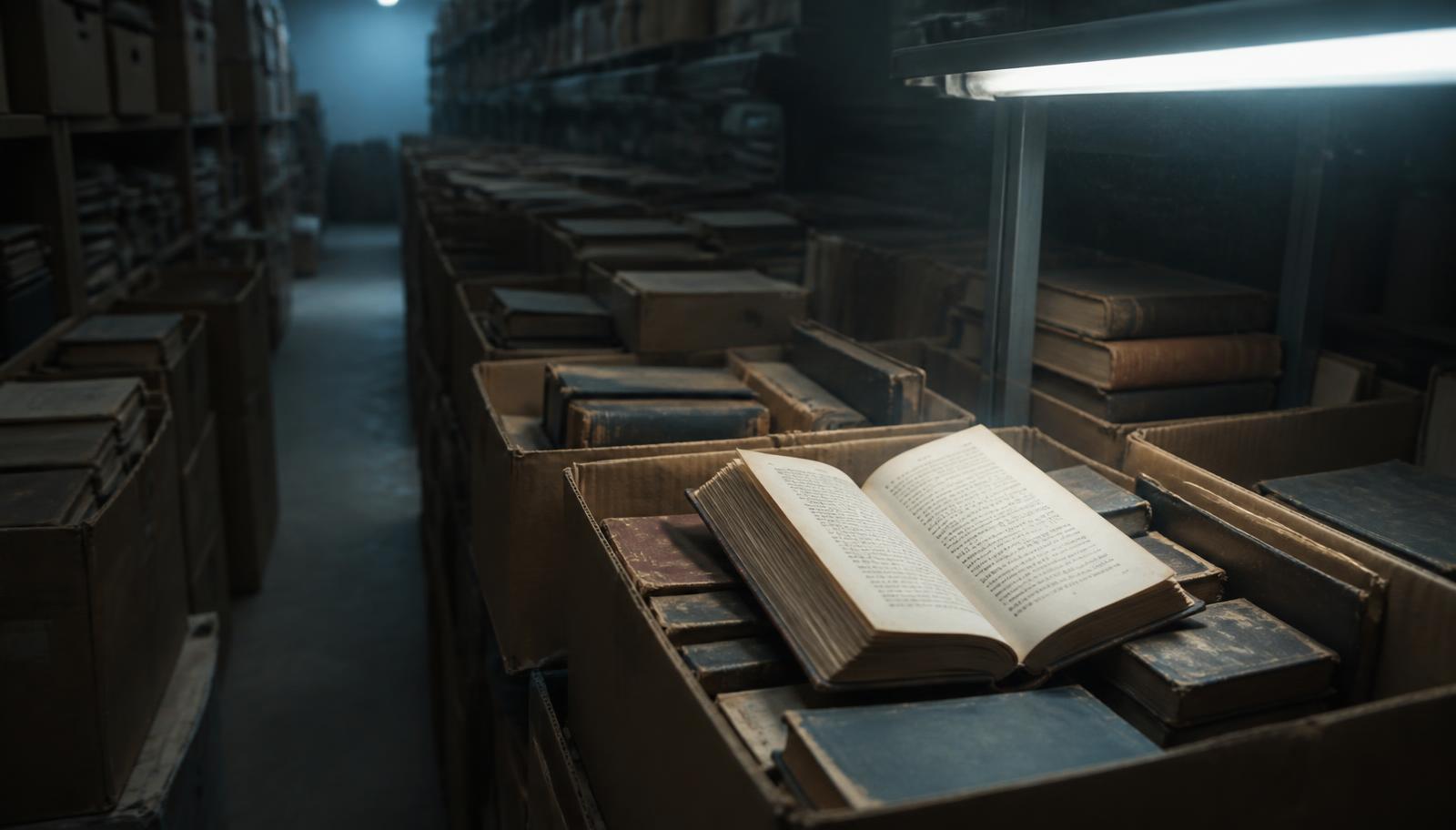
Over the past few months, booksellers in the UK and elsewhere have described a pattern that unsettles them: bulk orders for obscure, out-of-print, low-demand books. Not first editions. Not collectables. Whole shelves of the unglamorous middle of the trade, bought quickly and shipped to addresses that tell you nothing. The Guardian reported sellers'' concerns, and a common theory is that some of these books are being acquired to be scanned as training data for AI models.
We want to be plain about this at the top: that explanation is a suspicion, not a confirmed fact. Bulk buying happens for many mundane reasons, including library supply, wholesale arbitrage, academic collection building and plain speculation. Nobody has produced conclusive evidence tying these particular orders to AI training. What is confirmed is that sellers noticed something and found it strange enough to talk about publicly.
Why obscure books still matter
The books being bought are precisely the ones a market normally treats as worthless. A 1974 regional planning report. A parish history printed in an edition of 300. A translated poetry collection nobody reviewed. Bad novels by writers who never got a second contract.
These are the books that carry the texture of a period. Bestsellers tell you what a culture congratulated itself on. Obscure books tell you what it actually did on a Tuesday. Historians, genealogists, local researchers and curious readers rely on exactly this long tail, and it exists almost entirely in second-hand form because it was never reprinted and never will be.
Preserving knowledge versus consuming it as data
There is an important distinction here that gets flattened in the arguments. Digitising a book so people can read it is preservation. The Internet Archive, university digitisation projects and Project Gutenberg all made obscure texts more available, not less.
Ingesting a book as training material is a different transaction. The text is absorbed into a statistical model, the source stops being reachable, and the reader gains nothing they could open, cite or lend. The knowledge becomes an ingredient rather than a thing.
Neither of those is inherently the same as destroying a book, and the reporting does not establish that books are being destroyed. But scanning at volume often means guillotining spines, because a debound book feeds a sheet scanner far faster than a bound one. If that is happening at scale to titles with only a few hundred surviving copies, the practical result is fewer copies in the world, whatever the intent.
Why physical availability is the thing worth defending
A book on a shelf has a property no database has: it stays readable without anybody''s permission. No login, no licence, no terms of service, no company deciding the archive is no longer commercially viable. Digital access has repeatedly proved reversible. Print copies are stubborn.
Scarcity in the second-hand trade is not really about price. It is about whether a specific text still exists in a form a person can find. Once a low-value title falls below a certain number of circulating copies, it effectively leaves public reach, and nobody notices until somebody needs it.
How person-to-person resale keeps books alive
This is the part of the story we sit inside, so treat us as interested parties. When a book moves from one reader to another, it stays in circulation, stays findable, and stays in a house rather than a container. Multiply that a few hundred thousand times and you have a distributed archive that no single buyer can quietly hoover up.
Charity shops and independent dealers do the same work, and they do it with better instincts than any algorithm. The person who prices a strange local history at three pounds and puts it in the window is running a preservation programme without calling it one.
Practical things that help, none of which require a view on AI:
- Sell or pass on the odd books, not just the popular ones. The unfashionable titles are the ones actually at risk.
- Record the ISBN or, for older books, publisher and year, when you list something. Findability is preservation.
- Buy the out-of-print book you keep meaning to read from a person rather than waiting for a reprint that will not come.
- If a bulk enquiry feels off, ask what the books are for. Sellers are allowed to be curious.
What we do not know
We do not know who is buying. We do not know whether the books are being scanned, shelved, resold or pulped. We do not know whether the pattern is coordinated at all or a coincidence that got a narrative attached. Anyone claiming certainty in either direction is ahead of the evidence.
What we do think is defensible: the value of a book is not settled by what it sells for, and a culture that lets its least valuable books disappear will notice the gap decades later, when it is far too late to fix.
Your turn
Have you had an unusual bulk enquiry, or watched an obscure title vanish from the market? Tell us about it. And if you have a strange, unloved, out-of-print book sitting in a box, put it somewhere a reader can find it. That is the whole mechanism.