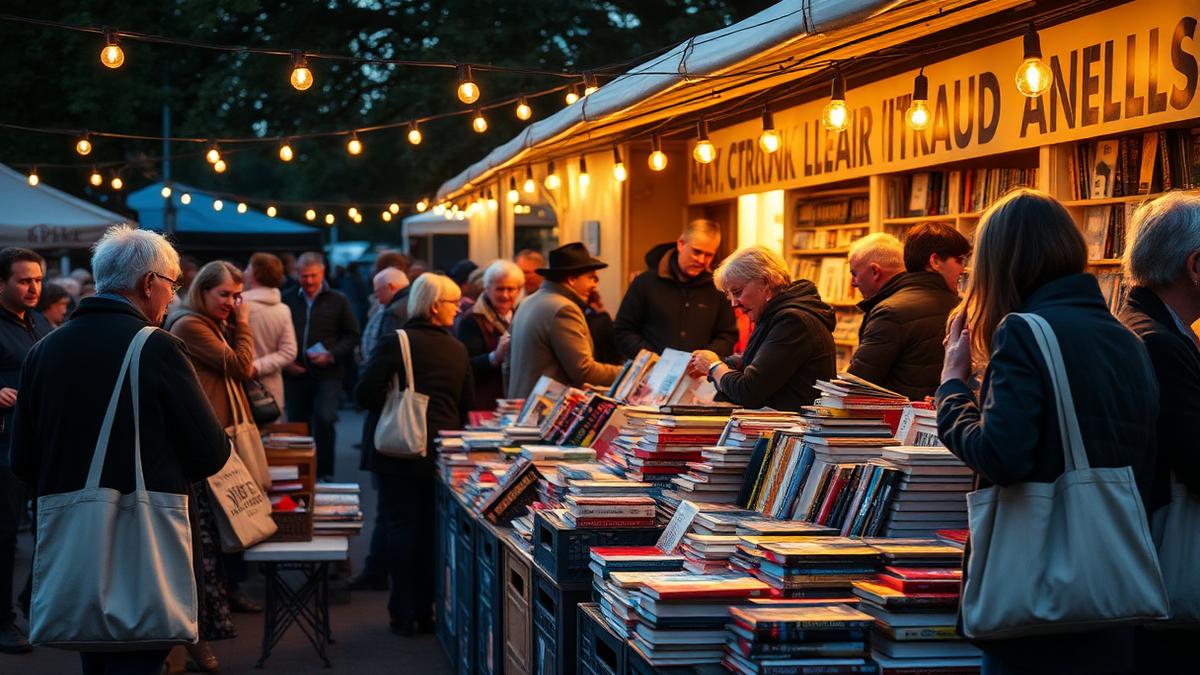
Reading looks like a solitary year until you map it. Then it turns out there is something on almost every month, most of it free, and a lot of it involving crates of second-hand paperbacks.
Dates for the diary
Here are the fixed points worth building a reading year around. Dates below are the confirmed 2026 and early 2027 dates; always check the organiser before booking travel.
- Edinburgh International Book Festival - Sat 15 to Sun 30 August 2026. Around 600 events and 600 writers from 41 countries, themed Changing Your Mind, at the Edinburgh Futures Institute, McEwan Hall and, new for 2026, Greyfriars Kirk.
- Booker Prize 2026 shortlist - Tuesday 22 September 2026, announced at a public event at the Southbank Centre, London. The longlist of 13 was chosen by a panel chaired by Mary Beard, with Jarvis Cocker, Raymond Antrobus, Rebecca Liu and Patricia Lockwood.
- Bath Children's Literature Festival - Friday 25 September to Sunday 4 October 2026.
- Wigtown Book Festival - 25 September to 4 October 2026, in Scotland's National Book Town.
- National Poetry Day - Thursday 1 October 2026, theme Wonder. Around 1.5 million people take part, mostly through free library and school events.
- Cheltenham Literature Festival - 9 to 18 October 2026. The world's longest-running literature festival, established in 1949.
- Oxford Literary Festival - Saturday 13 to Sunday 21 March 2027.
- World Book Day - Thursday 4 March 2027, following the National Year of Reading in 2026.
- Bukhman International Booker Prize 2027 - longlist Tuesday 16 March 2027, shortlist Thursday 15 April 2027, winner announced in May 2027. Katie Kitamura chairs the judges.
- Hay Festival - late May, ten days of more than 500 events in Hay-on-Wye. The 2026 edition ran 21 to 31 May with Emma Thompson, Dawn French, Malala Yousafzai and Gisele Pelicot among the headliners.
Two more worth noting because tickets are rarely the point: Independent Bookshop Week in June and Bookshop Day in early October, run by the Booksellers Association with around 1,000 UK shops taking part. Both are free, both are basically an excuse for a bookshop crawl.
Winter: swaps and long books
January and February are the season of the book swap. They cost nothing to run: everyone brings three books they have finished, they go on a table, everyone leaves with three different ones. Village halls, offices, gyms and workplaces all work. It is also the only time of year people willingly start a 700-page novel.
Run one yourself
- One table, one rule: bring at least one, take no more than you brought.
- Leftovers go to a charity shop the same day. Never store them.
- Put a "recommend it out loud" jar of index cards next to the table.
Spring: the prize season
Spring brings the big shortlists and award announcements. The International Booker Prize sets the tone: the 2026 winner, Taiwan Travelogue by Yang Shuang-zi, translated by Lin King, was announced at Tate Modern on 19 May 2026, the first book translated from Taiwanese Mandarin to take the prize. The 2027 cycle runs to the same rhythm, with the longlist on 16 March and the shortlist on 15 April 2027.
The trick for readers on a budget: shortlisted books flood the second-hand market roughly six to twelve months after a prize, so read last year's shortlist this spring at a fraction of the price. Libraries run free shortlist reading challenges too, and the Booker longlists are published in full online, which makes them the cheapest reading list in the country.
Late spring: World Book Night and giveaways
Late April brings World Book Night, which exists specifically to get books to people who do not usually read. Libraries, hospitals and prisons take donations. If your group has a stack of duplicates, this is where they should go.
Summer: festival season
The UK festival calendar runs from May through October, and you do not need a full pass to enjoy it. Hay Festival opens the season in late May, Edinburgh takes over the second half of August (15 to 30 August in 2026), then autumn belongs to Wigtown and Bath in late September and Cheltenham from 9 to 18 October. Smaller regional festivals fill the gaps: Wolverhampton and Faversham in February, Stratford in the spring, and dozens more listed in the UK book festival calendars kept by bloggers and by Literature Alliance Scotland.
Most of these festivals have free fringe events, outdoor stages, second-hand book stalls and signing queues that anyone can join. Programmes usually go on sale months ahead - Edinburgh's 2026 public on-sale was 5 May, with members booking from 30 April - so the diary matters more than the budget.
- Do the stalls, not just the talks. The best value at any literary festival is the crates.
- Volunteer. Many festivals swap a few shifts for access.
- Independent Bookshop Week in June is the best excuse of the year for a bookshop crawl.
Autumn: the reading new year
September behaves like January for readers. New releases land, book clubs restart, and there is a genuine appetite for something difficult. It is also the strongest month to launch a group: everyone is already resetting their diary.
Winter again: readathons and reading weeks
Late in the year, readathons and end-of-year lists take over. A group readathon works well as a fundraiser: pick a total page count, sponsor it, split the money between a local library or literacy charity.
The best reading year is not the one with the most books. It is the one with the most rooms.
Doing it all cheaply
Almost every event above works better with pre-loved copies: swaps depend on them, festivals sell them, clubs run on them. Buying second-hand keeps a full reading year cheap and keeps books in circulation instead of in landfill. Good for your pocket, good for the planet.
How to plan the year in one evening
The trick to a full reading year is not enthusiasm in January, it is a diary in January. Sit down once, put four anchors in the calendar, and the rest fills itself in: a swap in winter, a festival day in summer, a bookshop crawl in June, a readathon before Christmas. Four fixed points across twelve months is enough structure to make everything else feel spontaneous rather than chaotic.
- Book the dates before you know the details. Events publish late; your calendar does not care.
- Travel in pairs. Almost everything on this calendar is more fun and cheaper shared.
- Keep a running list of books you want to find rather than books you want to buy. Second-hand stock is a lottery and a list turns browsing into hunting.
Getting the most out of a festival day
Full festival passes are expensive and mostly unnecessary. A well-planned single day beats a badly planned weekend. Arrive early for the second-hand stalls before the good crates are picked over, pick one paid talk rather than three, and spend the rest of the day on free fringe events, outdoor stages and signings. Bring a tote bag you are prepared to fill and cash for the stalls that still do not take cards.
Volunteering deserves its own line. Most UK festivals will trade a few shifts for access, and stewarding is a genuinely good way to meet other readers, which is usually why people came in the first place.
The library year
Libraries run the most underrated calendar in the country: reading challenges, author visits, local history talks, children's summer schemes, shortlist groups, and free rooms you can book for your own group. They are also the cheapest way to test whether you actually like a book before hunting a copy to keep. If your reading year feels thin, the fix is usually a library card rather than a bigger budget.
Running your own event without a budget
Everything on this calendar can be replicated locally at almost no cost:
- Swap. One table, one rule, leftovers to a charity shop the same day.
- Silent reading hour. A cafe, phones away, sixty minutes, then a drink.
- Shortlist night. Six readers, six shortlisted books, one each, thirty minutes of pitches and a vote.
- Sponsored readathon. A page target, a local literacy charity, a spreadsheet.
- Bookshop crawl. Three shops, one budget, one book each, coffee in between.
Announce them in the least glamorous way possible: a message to five people with a date and a place. Posters recruit nobody. Direct invitations recruit almost everybody.
What a full reading year actually feels like
Twelve months of this is not a heroic reading total. It is a handful of rooms, a few new faces, a shelf of paperbacks with other people's names in the front, and a diary that had something in it other than work. The books are the excuse; the calendar is what turns reading from a private habit into a year you can remember.