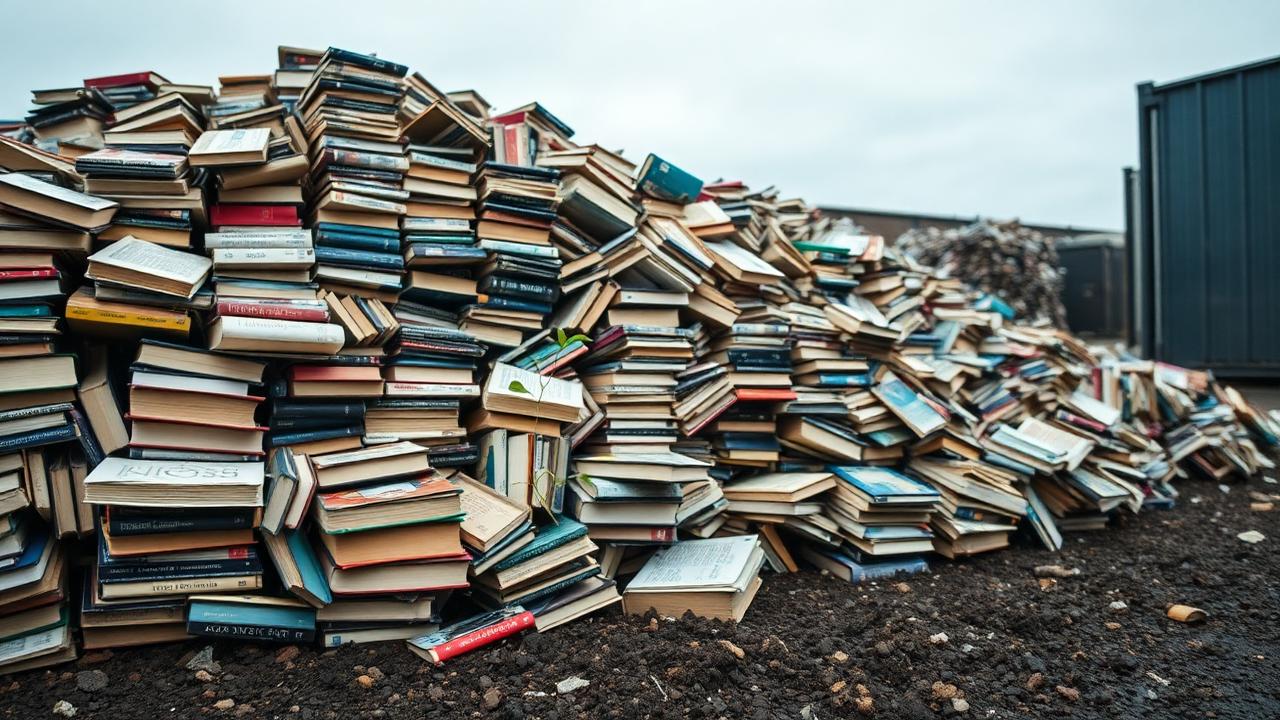
There is a bag by somebody''s front door right now. Twenty or thirty books in it, tied at the top, destined for a charity shop on Saturday. It has been there since March. This is not a story about villains. It is a story about the small, guilty inertia that decides the fate of most unwanted books in this country.
The waste nobody sees
We have learned to feel something about plastic. A single-use bottle now carries a faint moral charge. Books carry the opposite charge: they feel virtuous by definition, which is exactly why their disposal goes unexamined. Nobody photographs a skip full of paperbacks. Nobody films the pulping line.
But books are made of the same industrial inputs as any other manufactured object. Pulped wood, water, ink, adhesives, coatings, and a long freight journey from printer to warehouse to shop to your shelf. The environmental cost of a book is paid almost entirely at the point of manufacture. Everything after that, every reader it passes to, is essentially free. Which makes a book thrown away after one read one of the least efficient purchases in a household.
The five fates of an unwanted book
Follow a book out of a house and it takes one of five paths, roughly in order of decreasing usefulness.
- It goes to another reader. Sold, swapped, lent, given to a friend, left in a book exchange. The manufacturing cost is now spread across two readers instead of one. This is the only outcome that changes anything at all.
- It reaches a charity shop and sells. Excellent. It funds something and it keeps reading. The caveat is capacity: shops are volunteer-run, shelf space is finite, and donations arrive in waves.
- It reaches a charity shop and does not sell. Unsold stock cannot sit forever. Much of it moves on to bulk resellers or to paper recycling, and neither is failure, but neither is what the donor pictured.
- It goes to paper recycling. Better than the alternative, and worth saying clearly: recycling a book is a genuine good. It is also a demolition. A finished object with years of use left in it is reduced back to fibre, using energy to do so, so that a lower-grade product can be made. It is the worst of the good options.
- It goes in general waste. Landfill or incineration. Everything that went into making it is gone, and the paper''s stored carbon goes with it.
Most of us intend option one and end up somewhere between three and five, because option one requires a decision and the others only require a bag.
Why hardbacks are the quiet problem
Ask any charity shop volunteer and they will tell you the same thing. Paperbacks move. Modern hardbacks, especially celebrity memoirs and the previous decade''s bestsellers, sit. They were printed in enormous quantities, everyone who wanted one got one, and now the country holds far more copies than it has readers who want them. They are also heavy, which makes them expensive to move and awkward to store.
The same logic applies to old textbooks and superseded editions, where a newer print run has quietly stranded thousands of perfectly readable copies. This is the real book waste story in the UK: not scarcity, but over-supply of the wrong titles in the wrong places, with no cheap way to connect them to the few people who still want them.
What one book is actually worth, environmentally
Precision here is impossible and anyone offering it to two decimal places is selling something. The honest position is a set of working estimates, which is what we use on our own Sustainable Shelf:
- Roughly 2.5kg of CO2 avoided per book rehomed instead of newly printed, counting paper, ink and transport.
- Roughly 7.5 litres of water saved against the pulp and paper production of a new copy.
- Around 20 books to a tree, as a rough paper-yield equivalence.
Treat those as order-of-magnitude figures designed to make an invisible thing visible, not as measurements. What they are useful for is scale. That stalled bag of thirty books by the front door represents something like 75kg of CO2 and a couple of hundred litres of water, sitting in a hallway. Sixty books, and you are into a tree.
Which is a modest, unglamorous number. It will not offset a flight. But it is unusually cheap to achieve, it requires no new technology, and unlike most environmental gestures it pays you rather than costing you.
The awkward truth about buying second-hand
One honest caveat, because the sustainability case for used books is often overstated. If a book travels a long way in its own van to reach you, some of the saving goes on the journey. Buying second-hand is not a licence to buy without limit, and forty impulse purchases you never read are not virtuous just because they were pre-loved.
Two things keep the sums genuinely favourable: bundling, so several books from one seller travel together in one parcel rather than four, and actually reading what you buy. A read book has done its job. An unread book on a shelf has only changed address.
What to do with the bag by the door
In rough order of impact:
- Sort it before you move it. Ten minutes splits the bag into books somebody definitely wants, books with a niche audience, and genuinely finished books. Different destinations, different outcomes.
- Sell or list the first two piles. Not for the money, though the money is pleasant. Because listing is the only route that reliably connects a specific book to the specific person searching for it, which is the thing charity shelves and recycling bins cannot do.
- Donate what suits a local shelf. Recent paperbacks and popular fiction do well. Consider asking what they are short of rather than what you are long of.
- Recycle the genuinely finished ones. Water-damaged, mouldy, spine collapsed, 1997 tax guide. Remove any plastic-coated covers if your council asks. This is the right answer for these and you should not feel bad about it.
- Nothing in general waste. A book has no business in landfill. It is paper and it is recyclable at worst.
The circular economy already existed
Second-hand books were doing circular economy long before anyone had the phrase. Every market stall, every honesty box outside a village hall, every dog-eared paperback passed between friends is the same mechanism: keep the object in use, spread its cost across as many readers as possible, delay the day it becomes fibre again.
The only thing that has changed is that the matching problem is now solvable. Somebody in Carlisle wants the book in your hallway. Twenty years ago there was no realistic way for the two of you to find each other. Now there is, and it takes about a minute a book.
Good for your pocket, good for the planet. In that order, honestly, because the second only happens at scale if the first is true.